- Products
- Air Compressors & Air Tools
- Climate Control
- Compaction Equipment
- Concrete Cutting Tools & Equipment
- Concrete and Masonry
- Demolition & Excavation
- Electrical & Mechanical
- Fasteners and Anchoring Adhesives
- Floor Protection
- Generators and Welders
- Hand Tools
- Heaters
- Janitorial and Office Supplies
- Jobsite Protection
- Ladders & Storage
- Lighting & Lighting Accessories
- Man Lifts
- Material Handling Equipment
- Power Tools
- Pressure Washers & Pumps
- Safety Gear
- Safety Products
- Saws
- Surface Preparation
- SEASONAL PRODUCTS
- Rentals
- Air Compressor and Air Tool Rentals
- Climate Control Rental
- Compaction Rentals
- Concrete Equipment Rentals
- Demolition & Excavation Equipment Rentals
- Concrete Floor Grinder Rentals
- General Construction Equipment Rentals
- Generator Rentals and Welder Rentals
- Heater Rentals
- Light Tower Rentals
- Man Lift Rentals in Massachusetts and Rhode Island
- Material Handling Equipment Rentals
- Pressure Washer & Pump Rentals
- Saw Rentals in New England
- SEASONAL PRODUCTS
- Products
- Air Compressors & Air Tools
- Climate Control
- Compaction Equipment
- Concrete Cutting Tools & Equipment
- Demolition & Excavation
- Electrical & Mechanical
- Floor Protection
- Generators and Welders
- Construction Heaters
- Construction Ladders, Staging, & Storage
- Construction Lighting
- Man Lifts
- Material Handling Equipment
- Industrial Janitorial and Office Supplies
- Pressure Washers & Pumps
- Construction Safety Products
- Construction Safety Gear
- Surface Preparation
- Building Protection
- Diesel Accessories
- Zero Emissions
- Rentals
- Air Compressor and Air Tool Rentals
- Climate Control Rental
- Compaction Rentals
- Concrete Equipment Rental
- Demolition & Excavation Equipment Rental
- General Construction Equipment Rental
- Generator Rentals and Welder Rentals
- Construction Heaters Rental
- Light Tower Rentals
- Man Lift Rentals
- Material Handling Equipment Rental
- Pressure Washer & Pump Rentals
- Saw Rentals in New England
- Concrete Floor Grinder Rentals
- Zero Emissions Rentals
- Repairs & Used
- Parts
- Blog
- Services
- Resources
- About Us
- Contact Us
Sales & Rental of Construction | Industrial Equipment & Supplies


2026 How to Choose a Mobile Chipper Machine?
Choosing a mobile chipper machine in 2026 requires more than comparing engine horsepower and advertised production rates. A reliable decision begins with the worksite. Consider branch diameter, wood species, daily volume, ground conditions, transport distance, and operator experience. A compact machine may move easily between narrow streets, while a larger unit can process hardwood logs faster. However, excessive capacity can increase fuel use, maintenance costs, and downtime.
Forestry equipment specialist Dr. Raffaele Spinelli offers a useful principle: “Productivity depends on the complete harvesting system, not one machine alone.” This idea matters when evaluating a Moved Chipper Machine for municipal pruning, landscaping, or forest residue. Check the feed-table height, discharge reach, rotor design, blade access, and emergency-stop locations. Picture the actual job: wet branches beside a curb, stones hidden under brush, and a truck waiting fifteen minutes away. Small details become expensive quickly.
Specifications can mislead. They often describe ideal material, skilled operators, and perfect weather. Real conditions are less cooperative. A machine that performs well during a demonstration may struggle with tangled limbs or uneven ground. Buyers should request service records, parts availability, warranty terms, and a practical trial with local material. Noise, emissions, transport rules, and operator protection also deserve attention. There is no universal best choice. The correct machine balances output, mobility, safety, ownership cost, and repair support. Even experienced buyers sometimes overlook after-sales service. That mistake can stop a profitable operation.
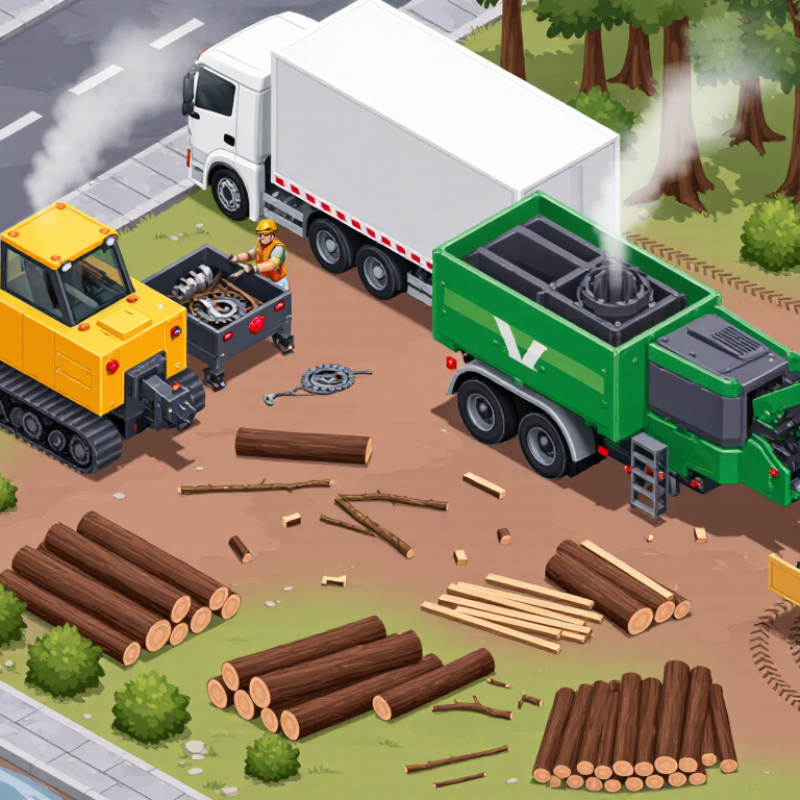
Table of Contents [Hide]
What Is a Mobile Chipper Machine and How Does It Work?
A mobile chipper machine is a movable system that reduces branches, logs, and woody residues into chips. It usually combines a feed hopper, hydraulic rollers, cutting knives, a rotor, and a discharge chute. Feed rollers pull material inward. Rotating knives cut it against a fixed counter-knife. A screen then helps control chip size. The chute directs chips into a truck, trailer, or ground pile.
The process is mechanical, but material condition changes everything. Fresh branches feed smoothly. Wet, crooked, or contaminated wood can slow production and damage knives.
The FAO’s Global Forest Resources Assessment 2020 estimates that forests cover 31% of global land, equal to about 4.06 billion hectares.
This large resource creates demand for practical residue-processing equipment. The U.S. Energy Information Administration reported that biomass supplied about 5% of total U.S. energy consumption in 2023.
In 2026, choose a machine by workload, not appearance. Check maximum feed diameter, hourly throughput, engine power, chip-size control, and transport weight. A tracked model suits uneven woodland. A towable model may work better beside roads or job sites. Safety features matter too, including emergency stops, guarded feed areas, and clear maintenance access.
A neat specification sheet can still mislead. Actual output depends on operator skill, wood moisture, knife sharpness, and feeding rhythm. Smaller units may consume less fuel, yet struggle with dense hardwood. Larger machines offer capacity, but increase transport and maintenance demands.

© Copyright - Pro Tool & Supply - Site by SVM E-Marketing Solutions - Sitemap
- Privacy policy