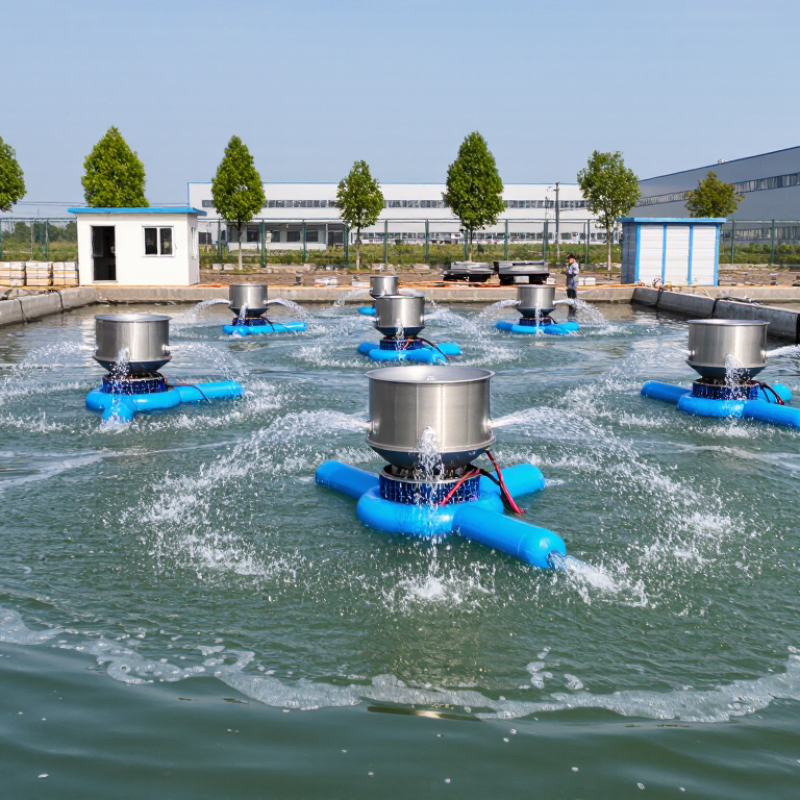
| Aerator Type | Floating pump aerator with a surface-mounted pump, intake passage, and upward or radial water discharge. | Combines water circulation with surface agitation, helping improve oxygen transfer and reduce stagnant areas in ponds and tanks. | Product structure drawing, operating video, technical data sheet, and installation instructions. |
| Motor Power | Common commercial configurations generally range from 0.75 kW to 7.5 kW; larger systems may use multiple units. | Power selection affects water movement, energy consumption, oxygenation capacity, and suitability for pond size and stocking density. | Rated power, voltage, frequency, rated current, motor efficiency data, and recommended application range. |
| Flow Rate | Typical product specifications may range from approximately 20 to 180 m³/h, depending on motor power, pump design, and discharge height. | A higher flow rate can improve circulation, but the actual result depends on pond geometry, water depth, temperature, and organic loading. | Flow-versus-head curve, tested flow rate, measurement conditions, and pump outlet dimensions. |
| Oxygen Transfer Performance | Performance should be stated using recognized measurements such as standard oxygen transfer rate (SOTR) or standard oxygen transfer efficiency (SOTE), rather than horsepower alone. | Motor power by itself does not accurately indicate oxygenation performance. Standardized testing supports fair comparison between products. | Test method, water temperature, dissolved oxygen conditions, SOTR or SOTE results, and laboratory or in-house test records. |
| Float and Frame Construction | Use UV-resistant, impact-resistant floats and a corrosion-resistant frame made from suitable polymer, stainless steel, or coated metal components. | Floating components must remain stable under wave action, sunlight, changing water levels, and repeated starting and stopping. | Material specifications, float buoyancy data, load rating, UV-resistance information, and structural drawings. |
| Corrosion Protection | Water-contact parts should use corrosion-resistant materials or protective coatings appropriate for freshwater, brackish water, or wastewater conditions. | Corrosion can reduce service life, damage fasteners, increase maintenance costs, and affect water-contact components. | Material certificates, coating specifications, fastener grade, salt-spray or corrosion-test information, and maintenance recommendations. |
| Electrical Safety | Provide suitable ingress protection for the operating environment; outdoor motor assemblies commonly require an enclosure rating such as IP55 or higher, subject to the design and certification. | Proper protection helps reduce the risk of dust and water entering electrical components during outdoor operation. | IP test report, insulation test results, grounding instructions, overload protection details, and applicable conformity documents. |
| Power Compatibility | Available configurations should clearly identify operating voltage, frequency, phase, cable length, and starting method. Common industrial supplies include 220–240 V or 380–415 V at 50/60 Hz, depending on the market. | Correct electrical matching prevents overheating, poor performance, nuisance tripping, and installation delays. | Electrical nameplate, wiring diagram, current rating, phase information, and compatible control-panel specifications. |
| Control and Protection | Recommended controls include overload protection, short-circuit protection, phase-loss protection for three-phase units, leakage protection, and optional timer or automatic control. | Protection systems improve operational safety and help limit damage caused by abnormal electrical or mechanical conditions. | Control-panel diagram, protection-device model specifications, alarm functions, and operating manual. |
| Operating Water Depth | Many floating units operate in ponds with approximately 0.8 to 3.0 m of usable water depth, but the exact requirement depends on intake design and float configuration. | Insufficient depth may cause vortex formation, air entrainment, unstable operation, or reduced pump performance. | Minimum water-depth requirement, intake clearance, anchoring layout, and installation photographs or drawings. |
| Noise and Vibration | Stable floats, balanced rotating parts, proper bearings, and correctly aligned shafts are essential for controlled vibration and acceptable operating noise. | Excessive vibration can loosen fasteners, shorten bearing life, damage cables, and disturb nearby facilities or livestock. | Factory run-test records, vibration inspection results, bearing specifications, and recommended maintenance intervals. |
| Energy Efficiency | Compare performance using oxygen transfer per unit of energy, such as kg O₂/kWh, together with flow rate and operating conditions. | Energy efficiency has a direct effect on long-term operating cost, particularly for aerators running continuously or for extended periods. | Energy-consumption test data, motor efficiency class, operating current, SOTR or SOTE results, and duty-cycle recommendations. |
| Quality Control | Reliable production should include incoming-material inspection, electrical testing, insulation testing, leak inspection where applicable, and a full-load or no-load running test. | Documented quality control reduces the risk of premature failure and inconsistent performance between production batches. | Inspection checklist, test report template, serial-number traceability, nonconformity procedure, and pre-shipment inspection records. |
| Documentation | Technical documentation should include installation, operation, maintenance, troubleshooting, wiring, spare-parts, and safety instructions in clear English. | Complete documentation supports local installation, regulatory review, operator training, and after-sales maintenance. | English user manual, parts list, wiring diagram, preventive-maintenance schedule, and safety data. |
| Customization Capability | Useful options include voltage and frequency selection, cable length, float size, outlet direction, anchoring accessories, control panels, and corrosion-resistant materials. | Customization allows the equipment to match local electrical systems, pond layouts, climate conditions, and import requirements. | Configuration list, engineering-change process, approved drawings, customization lead time, and sample approval procedure. |
| Packaging and Export Readiness | Export packaging should protect floats, motors, cables, and control components from impact and moisture during handling and ocean transport. | Appropriate packaging reduces transit damage and supports efficient customs clearance and inland delivery. | Packing list, package dimensions and weight, moisture-protection method, shipping marks, spare-parts list, and export documents. |
| Warranty and Spare Parts | A written warranty should define coverage, exclusions, claim procedures, response time, and availability of wear parts such as bearings, seals, fasteners, floats, and electrical components. | Clear after-sales terms reduce downtime and provide predictable lifecycle support for international installations. | Warranty document, spare-parts price list, recommended stock list, service contact process, and replacement instructions. |