- Products
- Air Compressors & Air Tools
- Climate Control
- Compaction Equipment
- Concrete Cutting Tools & Equipment
- Concrete and Masonry
- Demolition & Excavation
- Electrical & Mechanical
- Fasteners and Anchoring Adhesives
- Floor Protection
- Generators and Welders
- Hand Tools
- Heaters
- Janitorial and Office Supplies
- Jobsite Protection
- Ladders & Storage
- Lighting & Lighting Accessories
- Man Lifts
- Material Handling Equipment
- Power Tools
- Pressure Washers & Pumps
- Safety Gear
- Safety Products
- Saws
- Surface Preparation
- SEASONAL PRODUCTS
- Rentals
- Air Compressor and Air Tool Rentals
- Climate Control Rental
- Compaction Rentals
- Concrete Equipment Rentals
- Demolition & Excavation Equipment Rentals
- Concrete Floor Grinder Rentals
- General Construction Equipment Rentals
- Generator Rentals and Welder Rentals
- Heater Rentals
- Light Tower Rentals
- Man Lift Rentals in Massachusetts and Rhode Island
- Material Handling Equipment Rentals
- Pressure Washer & Pump Rentals
- Saw Rentals in New England
- SEASONAL PRODUCTS
- Products
- Air Compressors & Air Tools
- Climate Control
- Compaction Equipment
- Concrete Cutting Tools & Equipment
- Demolition & Excavation
- Electrical & Mechanical
- Floor Protection
- Generators and Welders
- Construction Heaters
- Construction Ladders, Staging, & Storage
- Construction Lighting
- Man Lifts
- Material Handling Equipment
- Industrial Janitorial and Office Supplies
- Pressure Washers & Pumps
- Construction Safety Products
- Construction Safety Gear
- Surface Preparation
- Building Protection
- Diesel Accessories
- Zero Emissions
- Rentals
- Air Compressor and Air Tool Rentals
- Climate Control Rental
- Compaction Rentals
- Concrete Equipment Rental
- Demolition & Excavation Equipment Rental
- General Construction Equipment Rental
- Generator Rentals and Welder Rentals
- Construction Heaters Rental
- Light Tower Rentals
- Man Lift Rentals
- Material Handling Equipment Rental
- Pressure Washer & Pump Rentals
- Saw Rentals in New England
- Concrete Floor Grinder Rentals
- Zero Emissions Rentals
- Repairs & Used
- Parts
- Blog
- Services
- Resources
- About Us
- Contact Us
Sales & Rental of Construction | Industrial Equipment & Supplies


Top 10 Types of LED Tunnel Lights for Global Buyers?
Choosing the right Led Tunnel Light begins with safety, visibility, and operating conditions, not product appearance. A tunnel roof can look evenly illuminated while drivers still face glare, flicker, or dark patches. That difference matters during rain, dust, and sudden daylight changes.
The International Energy Agency reports that lighting represents roughly 15% of global electricity consumption. This explains the growing interest in LED upgrades, especially where tunnels operate continuously. The U.S. Department of Energy has also documented major LED gains in efficacy, controllability, and service life. However, energy savings alone cannot prove a successful installation. CIE 88:2019 and the PIARC Road Tunnels Manual emphasize adaptation zones, threshold lighting, interior lighting, exit areas, and maintenance planning. These requirements shape the ten product types discussed in this guide, including linear tunnel fixtures, high-output luminaires, emergency lights, and smart dimming systems.
Lighting researcher Peter R. Boyce states, “The purpose of lighting is to enable people to see.” That simple principle remains useful here. A powerful Led Tunnel Light can still fail when its beam creates reflections on wet pavement. A cheaper fixture may also become expensive after repeated cleaning and replacement. We should admit one limitation: published efficiency figures rarely reflect every tunnel’s dust, traffic speed, ceiling height, or control strategy. Therefore, global buyers need more than a catalog comparison. They need photometric files, tested glare data, thermal performance, ingress protection, driver reliability, and evidence from comparable projects. The following ten types provide a practical starting point, though no universal ranking fits every tunnel.
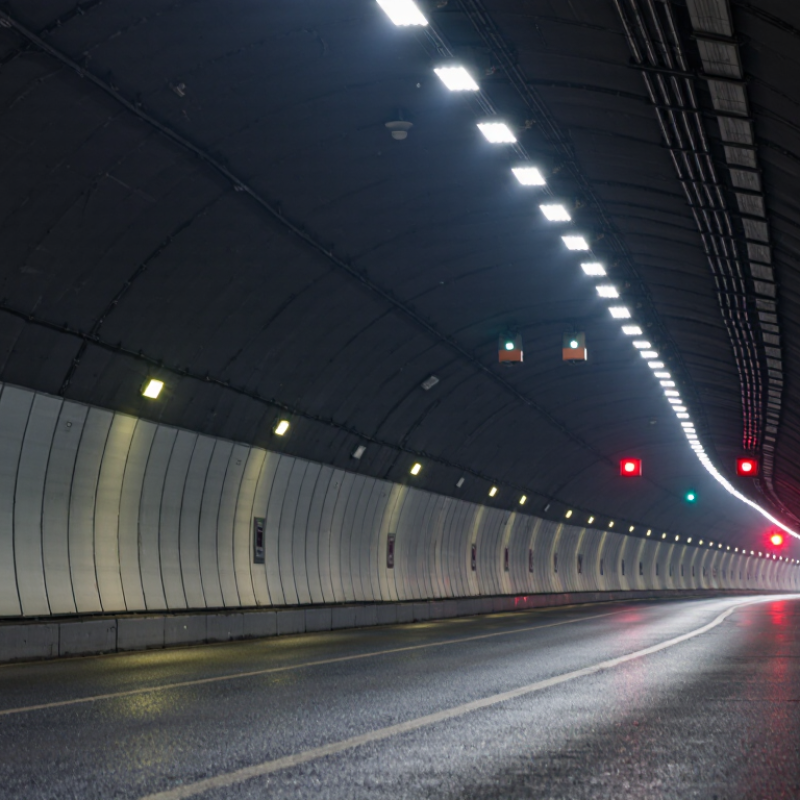
Table of Contents [Hide]
What Defines an LED Tunnel Light and How the Main Types Differ
An LED tunnel light is a purpose-built roadway luminaire for confined, demanding environments. It must provide stable illumination, manage heat, and resist dust, moisture, vibration, and exhaust residue. Unlike ordinary outdoor fixtures, tunnel lights support driver visibility during sudden changes from daylight to darkness.
The main types differ by optical distribution and installation position. Symmetric lights spread illumination evenly across the road. Asymmetric lights direct more output toward one side, helping reduce dark walls and uneven pavement brightness. Counter-beam lights project light against the traffic direction, improving object contrast near tunnel entrances. Pro-beam designs aim with traffic flow and can support entrance zones, where daylight creates severe visual adaptation problems. Continuous linear lights create an uninterrupted guide along the ceiling. Point-source luminaires offer easier replacement and flexible spacing. Low-profile models suit tunnels with limited clearance. High-output threshold fixtures handle bright entrance areas. Interior-zone lights use lower output after drivers adapt. Emergency-compatible units maintain essential visibility during power interruptions.
Details matter. Beam angle, mounting height, spacing, glare control, and dimming response should be checked together. A powerful fixture can still produce poor visibility when its optics are mismatched. Wide beams may brighten walls but waste energy on empty ceiling space. Narrow beams can create bright patches between dark areas. Not always obvious. Reliable selection also requires verified photometric data, suitable ingress protection, thermal testing, and compliance with local road-lighting requirements. Field assessments often reveal a practical weakness: maintenance access was considered too late. A tunnel light is only effective when operators can inspect, clean, and replace it safely.

© Copyright - Pro Tool & Supply - Site by SVM E-Marketing Solutions - Sitemap
- Privacy policy